


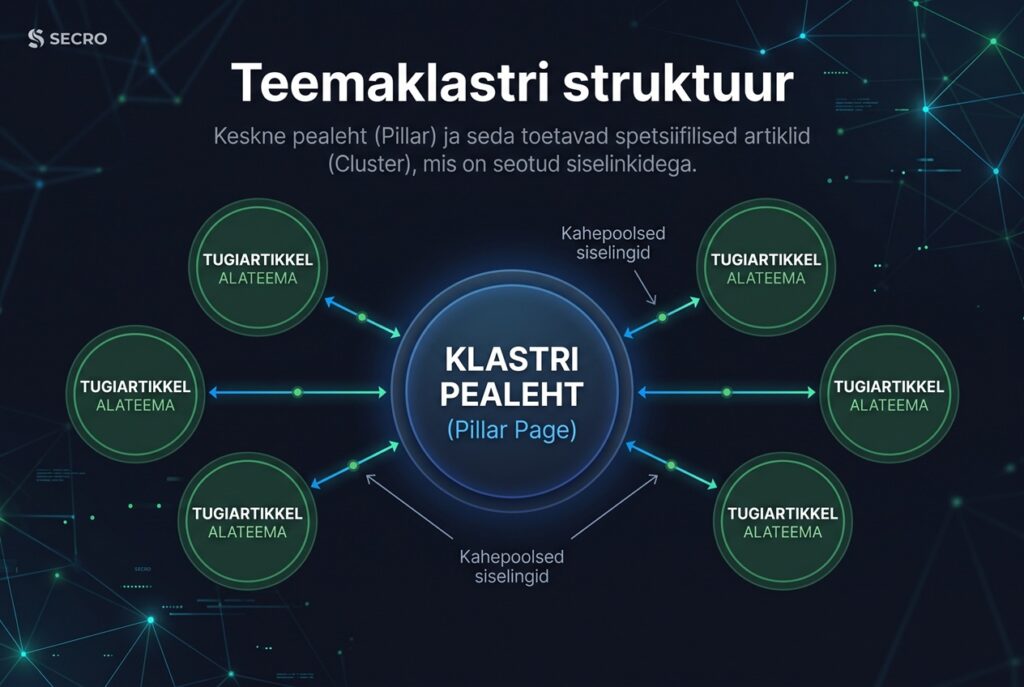
A topic cluster is a website content organization strategy that groups a broad main topic around a set of more specific supporting articles. Think of a topic cluster like a tree: the cluster pillar page forms a strong trunk, the supporting articles branch out from it, and a well-thought-out network of internal links breathes life into this entire structure. This structure sends a clear signal to humans, Google’s search engine, and artificial intelligence (AI) that you are an undisputed expert in the given field.
Years ago, SEO (Search Engine Optimization) worked simply: a separate landing page was created for every single keyword. Today, however, both search engines and AI models (Gemini, ChatGPT, Perplexity) have become smarter. They no longer look for individual keywords, but try to understand context and relationships. If your website consists of scattered and unlinked articles, it’s like a bundle of newspapers randomly thrown onto a shelf. A topic cluster, however, turns that bundle of newspapers into an organized and indexed encyclopedia.
The Anatomy of a Topic Cluster: Three Main Parts
A well-functioning topic cluster always consists of three inseparable components:
1. Pillar Page
This is the heart of the cluster – a long, thorough, and comprehensive page that covers all important aspects of the main topic, without going into too much detail on every single point. The purpose of the pillar page is to give the reader a complete overview.
Example: If your company offers accounting services, the cluster pillar page could be a comprehensive guide “Corporate Accounting for Beginners”.
2. Cluster Content (Supporting Articles)
These are specific articles or pages focused on a narrower topic or question. They take a subtopic briefly mentioned on the cluster pillar page and break it down in detail.
Example: Supporting articles could be “How to Submit an Annual Report?”, “What is the Difference Between a VAT Liable and Non-Liable Entity?”, or “How to Optimize Small Business Payroll Taxes?”.
3. Internal Linking Network
This is the glue that holds the cluster together. Every supporting article must contain a link back to the cluster pillar page, and the pillar page must link to all supporting articles. It is precisely this two-way linking that signals to search engines that the pages are interconnected and form a cohesive topical block.
How Does a Topic Cluster Affect Classical Visibility (Google SEO)?
Google has long stopped evaluating only a single page’s keyword density. Today, Google’s search results are driven by the E-E-A-T principle (Experience, Expertise, Authoritativeness, Trustworthiness).
A topic cluster is one of the strongest ways to achieve E-E-A-T:
- Topical authority: When Google’s crawler sees that you have created 10–15 high-quality and interconnected articles around a single main topic, the algorithm classifies your website as an authority in that field. You no longer rank well for just a single keyword, but begin to dominate the entire subject area.
- Better user experience metrics: Since the visitor easily finds related content, they stay on the website longer (lower bounce rate) and read multiple pages in a row.
- Link Juice Distribution: When one of your cluster’s supporting articles receives an external backlink (for example, someone shares it on social media or another blog links to it), this trustworthiness flows through internal links across the entire cluster, thereby raising the positions of the pillar page and other supporting articles as well.
Why Are Topic Clusters Critical in AI Searches (GEO)?
The future of search engines is tied to generative artificial intelligence (Generative Engine Optimization or GEO). ChatGPT, Perplexity, Claude, and Google’s own AI Overviews do not read the web like the old Google algorithm. Artificial intelligence tries to understand entities and the semantic relationships between them.
When a user asks ChatGPT a complex question (for example: “What is the best accounting software for an e-commerce store operating in Estonia?”), the AI needs a validated, rich, and contextual primary source to generate the answer.
If your website has a single isolated blog post, it is difficult for the AI to assess its truthfulness. However, if artificial intelligence sees a comprehensive topic cluster, it can infer:
- This website covers the topic in-depth and possesses expertise.
- The information is logically connected and structured, which makes data analysis (the RAG or Retrieval-Augmented Generation process) many times easier and more reliable for the AI.
In short: a well-built topic cluster is the fastest way to train language models (LLMs) to recommend your brand as the primary expert.
How to Create Your First Topic Cluster (Step-by-Step Guide)
Klastri loomine nõuab planeerimist, kuid see aja investeering tasub endhiljem kuhjaga ära.
Step 1: Choose a Broad and Commercially Important Main Topic
Choose a topic that is critical to your business, but broad enough for you to write 5–15 separate sub-articles about it. (E.g., “Investing in real estate”, rather than a specific “How to buy an apartment in Mustamäe”).
Step 2: Map Out Subtopics and Questions
Find out what your potential customers are actually asking. Use Google search suggested questions (People also ask), customer service feedback, or SEO tools. Each specific question is a potential supporting article.
Step 3: Write and Publish Content
Create the cluster pillar page (preferably 1500+ words), which provides a broad overview. Then write supporting articles that go deep into the details.
Step 4: Build a Internal Linking Network
Perhaps the most critical step. Make sure the pillar page links to every supporting article (for example, using clear subheadings and references in the style of “Read our more detailed guide on topic X here”). Also, every supporting article must link back directly to the pillar page at least once.
Conclusion
A topic cluster is not just a trendy SEO trick, but a fundamental rule of website information architecture. By organizing your content into logical clusters, you build long-term digital capital. This improves the visitor user experience, increases visibility in classic search engines, and most importantly – gives artificial intelligence models the clean and reliable context they need to recommend your company.