


AI-powered search engines have changed the web traffic landscape. While good keyword optimization used to be enough, today the key to success is understanding content and creating value. Your goal is no longer just to find a keyword, but to answer a question in a way that exceeds the reader’s expectations. This is a strategy that makes your brand an authority in its field and ensures visibility in front of new AI engines.
Download the infographic
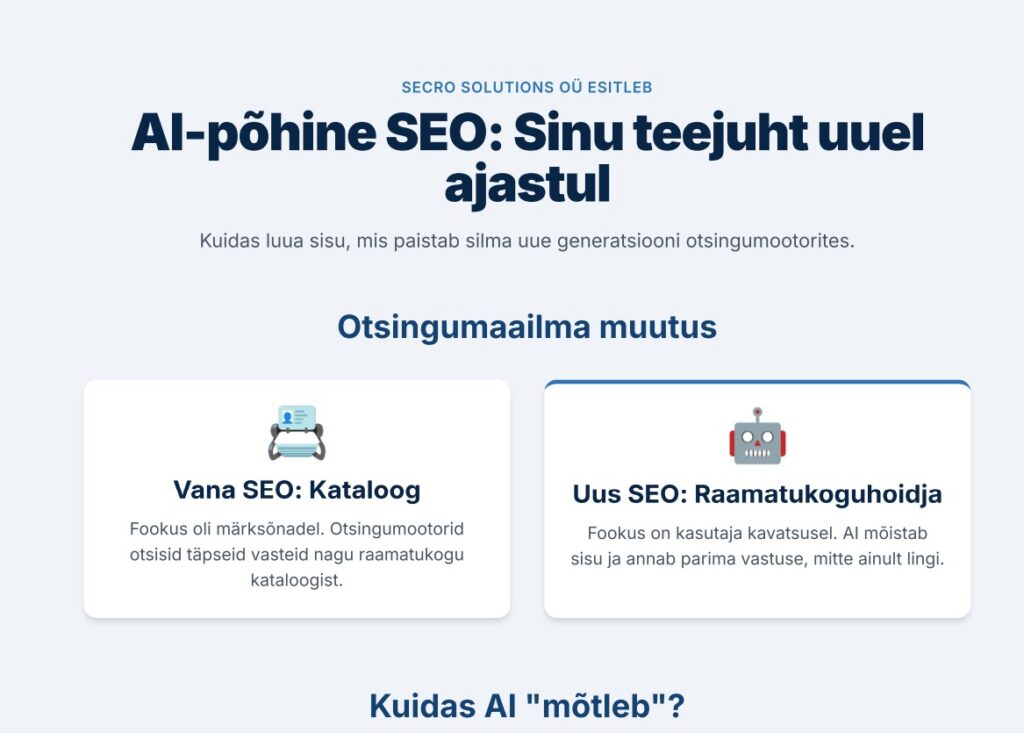
Download the AI-powered SEO Infographic. Click here!
1. Understand how AI search engines actually work
Traditional search engines were like library catalogs – they searched for books by titles and keywords. AI-powered search engines, however, are like knowledgeable librarians who understand the content of books and give you the best answer, even if you don’t know the title of the book.
Here are the main principles:
- Natural Language Processing (NLP): AI no longer just looks for keywords, but tries to understand entire sentences, context, and the user’s actual intent. It distinguishes between the word “bat” (animal) and “bat” (baseball bat).
- Generative AI: This is the biggest difference. AI analyzes data from multiple sources and creates a new, concise answer to your question, rather than just offering links.
- Vector models: This is the content of AI’s “brains”. Every word, sentence, and document is converted into a numerical vector. Concepts with similar meanings are located close to each other in this multidimensional space. For example:
- The vector for the word “cafe” would be in a “similar neighborhood” to vectors like “restaurant”, “coffee cup”, “latte”, and “eatery”.
- The word “running shoes” would be close to vectors like “sports shoes”, “sneakers”, “training”, and “marathon”.
- If your website’s content vector is close to the user’s query vector, AI will highlight you, even if your page doesn’t have the exact keywords. The logic of the vector model is precisely why depth of content and expertise are more important today than keyword density.
2. Think like an entrepreneur: How to turn this logic to your advantage?
Your action plan must be tailored to your business type.
- Local cafe/service provider: Use your Google Business Profile to its full extent (find help here) and encourage customers to leave reviews. The more detailed and positive the reviews, the more trustworthy your content vector is. Create content related to your location – for example, a blog post on “Best brunch spots in Tallinn”.
- Shop/e-shop: Don’t just write product descriptions, but also create valuable guides and content. For example, for a sports goods store: “How to choose the right running shoes for you?” Such content makes you an authority and increases your brand’s credibility in the eyes of AI. This helps AI understand that you are an expert in your field, not just a seller.
3. How to write articles that AI likes?
Before writing, you must think like a customer. What are their problems and concerns? This is the most important step that distinguishes the old approach from the new.
Mindset and questions before writing:
- Who is my target audience and what is their actual problem? For example, in a sports store, people don’t just search for “sneakers”, but want to know “how to avoid injuries when running by choosing the right sneakers?”.
- Do I have authority on this topic? Does my content add value or just repeat others? AI rewards originality.
- How can I structure the answer? How do I make the information easy to digest?
Useful tools for finding actual questions:
- Google’s own search results: Follow the “People also ask” and “Related searches” sections. These are the best free tools that show what else people are asking.
- Forums: Search for relevant forums on Facebook or other social media.
- Reddit and Quora: These are forums where people ask real questions, and they are mostly in English. Despite this, they can still be used. See which topics interest your target audience the most.
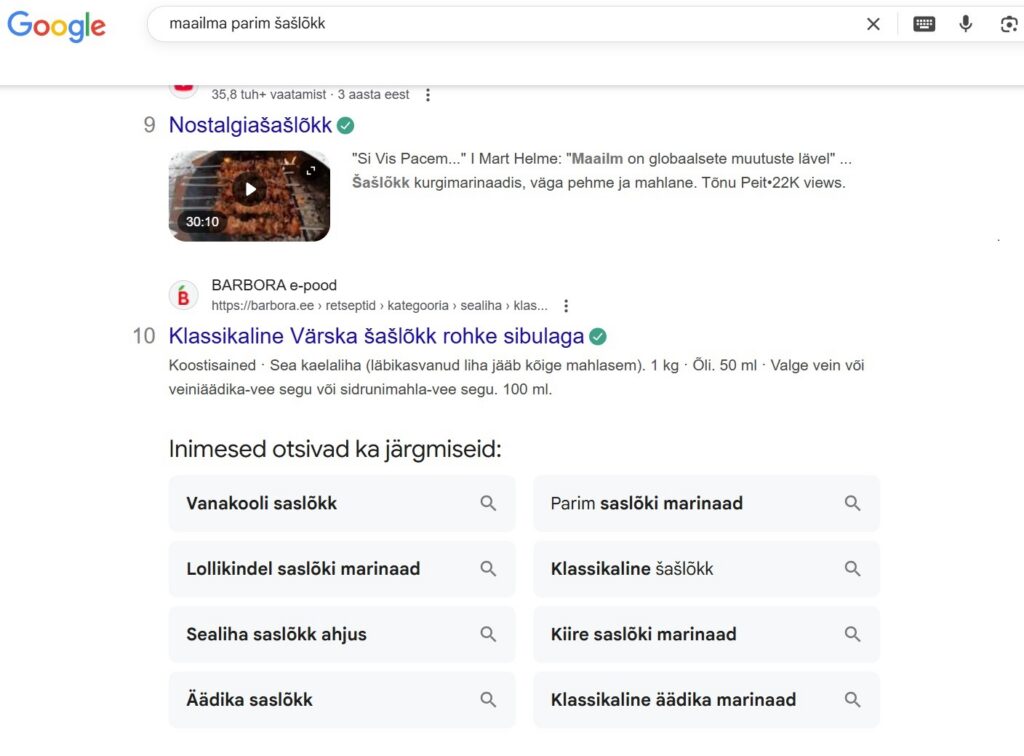
Checklist for content creation:
- The title (H1) should be clear and concise: “How to choose the right running shoes for you: 7 essential steps”.
- Subheadings (H2, H3) should be logical and answer questions: For example, under H2 “Understand your foot type”, there could be H3s “Pronation” and “Neutral pronation”.
- Use lists and tables: AI loves structured data. Lists and tables are easily processed and help generate answers.
- Add illustrations and multimedia: Images, videos, and graphics support the text and help AI understand the content better.
Checklist before publishing:
- [ ] Is my heading (H1) clear and concise?
- [ ] Is the text divided into logical subheadings (H2, H3)?
- [ ] Have I answered the main questions that my target audience is actually asking?
- [ ] Is the text easy to read and does it contain lists?
- [ ] Have I added images, tables, or videos?
- [ ] Am I convinced that this content is the best I can offer?
If you follow this mindset, you are already one step ahead of your competitors. This approach is long-term and secures a trustworthy place for your brand in the new, AI-powered search world.