


Search engines are no longer just collections of blue links. Artificial intelligence (AI) no longer searches for individual keywords, but tries to understand the deeper meaning of the content and answer the user directly. A Gartner study predicts (reference at the end of the article) that by 2026, traditional search volume could drop by up to 25% as users prefer AI answers and chatbots.
In order for your business to be represented in these answers, you need to move from keywords to topics and authority.
1. Structured Data or Schema Markup: Speak to AI in Its Native Language
Structured data (Schema Markup) is code that helps artificial intelligence understand the context of your content. It is like “subtitles” for the algorithm.
- Why is this important? AI models rely on specific relationships when classifying data. By clearly marking what a product is, who the author is, or what the service location is, you increase the likelihood of appearing in Google’s “Rich Results”.
- Study: An analysis by Milestone Research found (reference at the end of the article) that pages with structured data get an average of 41% higher click-through rate (CTR) than pages without them.
2. E-E-A-T: Your New “AI Insurance”
Google responds to the flood of AI-generated content with the E-E-A-T principle (Experience, Expertise, Authoritativeness, Trustworthiness).
- Experience and Expertise: AI cannot share personal experience. Google’s Search Quality Rater Guidelines emphasize that content must reflect the author’s actual competence. Add case studies and unique perspectives that a machine cannot replicate.
- Authoritativeness: Clearly show who the author of the content is. Google prefers content created by recognized experts to prevent the spread of “hallucinations” in search.
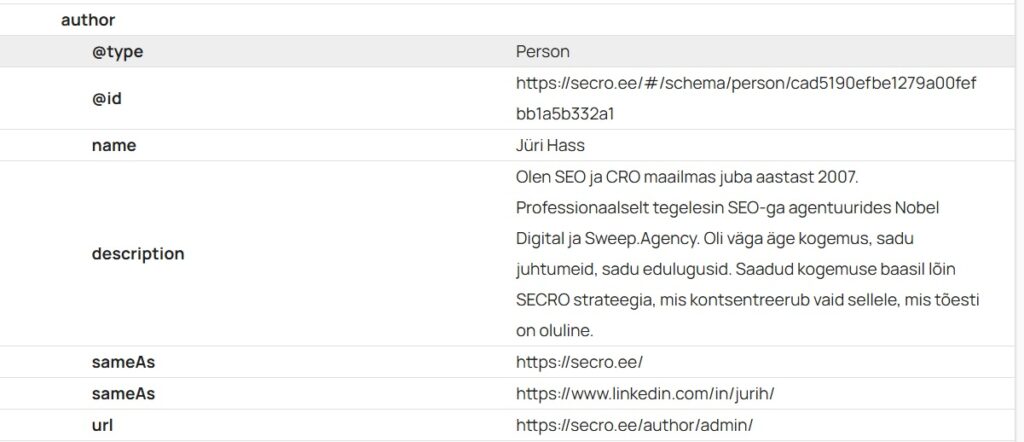
For example, at the end of this article, my information as the author is published, and additionally, at the code level (invisible to the human eye), there is a Schema structured dataset that is clear and understandable for AI. I also added an image here showing how this dataset looks in the Schema Markup Validator tool.
How to implement structured data in practice?
It is recommended to check the integrity of your website’s structured data (Schema markup) with the aforementioned official Schema.org testing tool. This ensures that artificial intelligence reads your page without errors.
If you use the WordPress platform, technical implementation is made easy – the necessary markup is largely automated. One of the most effective solutions for this is the Yoast SEO plugin.
Why choose the Yoast SEO plugin in particular?
Unlike many competitors, Yoast SEO already offers comprehensive functionality in its free version for optimizing both standard pages and e-commerce stores. It automatically creates a correct data hierarchy, helping search engines understand the connections between your content, organization, and products without you having to write any code.
3. Answer Questions (SGE and PAA Optimization)
AI searches are conversational. Users ask full sentences instead of typing individual words.
- Strategy: Use questions in subheadings and answer them immediately in the first paragraph. This is critical for Google’s Search Generative Experience (SGE) (Google’s generative search experience).
- Statistics: According to Search Engine Journal, Google’s “People Also Ask” (PAA) blocks already appear in almost 90% of searches. This is the primary source from which artificial intelligence draws its answers.
4. GEO (Generative Engine Optimization) – Optimizing for Generative Engines
The new direction in SEO is GEO. This means your content must be reliable enough for AI models (like GPT-4 or Perplexity) to cite you as a source.
- Study: A joint study by Princeton University and Georgia Tech (reference at the end of the article) on GEO showed that content that cites sources and is factually dense is up to 30% more likely to stand out in AI responses.
Expert recommendation: Don’t write for robots, but for humans in a way that robots understand. Always add unique data and personal opinion – this is the “datapoint” value that AI models hunt for.
Sources:
- Gartner: Predictions for 2024: Evolution of Search
- Milestone Research: The Impact of Schema Markup on CTR
- Google Search Central: Creating Helpful, Reliable, People-First Content
- GEO: Generative Engine Optimization Research Paper
Frequently Asked Questions (FAQ)
It does not replace it, but it changes the nature of SEO. Traditional keyword optimization is replaced by topical authority. The focus of SEO shifts from making a page visible to ensuring that AI trusts and cites your content as the best source.
Generative Engine Optimization (GEO) is a set of strategies aimed at making content visible and citable in the responses of AI models (such as Google Gemini, GPT-4, and Perplexity). It emphasizes factual accuracy, citation, and clear structure.
Google uses complex algorithms to detect patterns characteristic of machine-written text. Google’s official stance is that using AI is not prohibited, but content must comply with the E-E-A-T principle (experience, expertise, authoritativeness, trustworthiness). Low-quality, “spam-like” AI content will be penalized in search results.
Structured data is like a roadmap for artificial intelligence. It is code that unambiguously tells the algorithm what certain information means (e.g., what the price is, who the author is, when the event is). This reduces the AI’s chances of misinterpreting the content.
Yes, it is more important than ever. Since AI can synthesize existing information, unique, personal experience (Experience)< strong> is what a machine cannot copy. It is personal stories, tests, and opinions that give your content an edge over AI-generated text.