
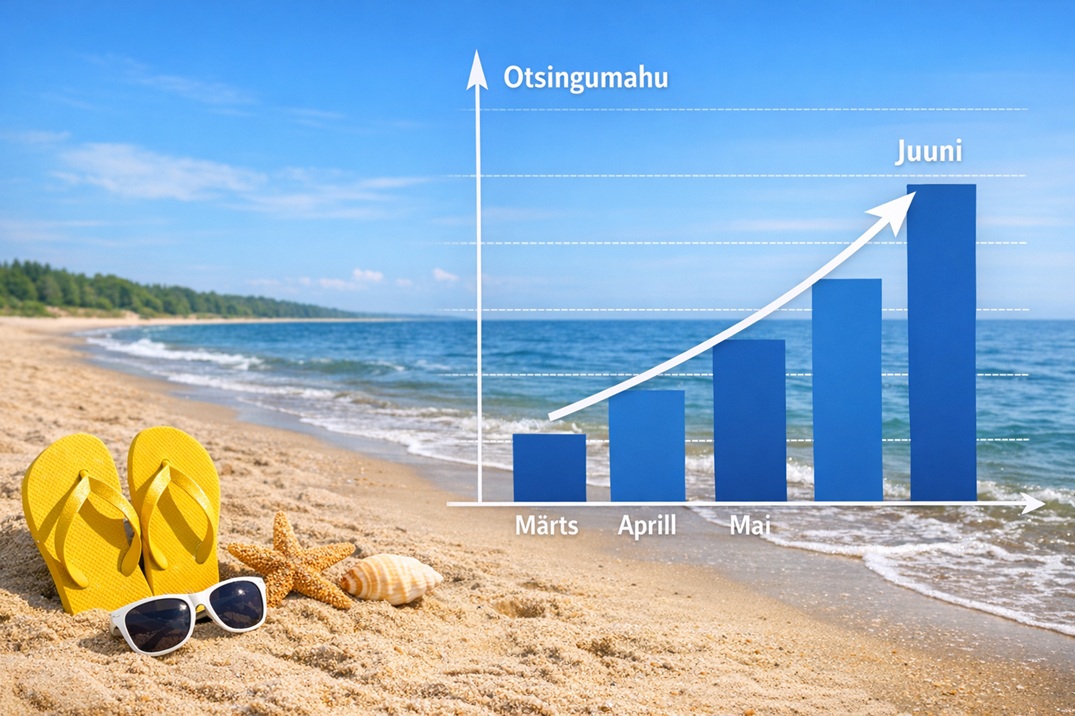
The Estonian e-commerce and services market has changed beyond recognition in recent years. In 2024, the sector's turnover in Estonia reached 5.2 billion euros, representing an 18 percent growth. Today, approximately 25% of all retail trade and services are conducted through online channels, and the tourism sector is at the forefront of this trend.
For tourism and accommodation companies, this means one thing: the fight for summer customers doesn't start on Midsummer's Day, but today.
Why are March and April critical for the tourism business?
Planning for domestic tourism and summer experiences in Estonia begins in the consumer's mind 3–4 months before the holiday. But for search engines, this time is even more critical. It takes an average of 4–6 months to achieve SEO results before the changes made in Google, Bing or artificial intelligence searches (AI Search) fully improve the position.
This means that if you want to be found for keywords like “holiday home in Southern Estonia”, “best summer restaurants”, or “active vacation for families”, the technical foundation and content of your website needs to be polished now. If you wait until May, you've already given up a large portion of your organic traffic to your competitors.
Economic background: Consumers have become more aware
Although the Estonian economy is forecast to grow by 2.1 percent GDP by 2026, consumer confidence has taken a hit in recent years. This is reflected in search behavior: people are doing more preliminary work, comparing prices and looking for added value.
SEO is not just about keywords — it’s about building trust. A consumer who discovers your service organically often trusts it more than intrusive paid advertising. In addition, considering the increase of the tax‑free minimum to 700 euros in 2026, we can expect a boost in domestic tourism — those who have secured a spot on Google’s first page by then will be the ones who benefit. Kui soovid, võin teksti ka stiililt lihvida või kohandada turunduslikumaks.
Mobile Speed: Winning or Losing the Tourism Customer
A large share of research and bookings in the tourism sector happens on mobile devices. This is where SEO and CRO (conversion rate optimization) collide in a particularly painful way.
According to the SECRO seasonality analysis, technical performance is critical: even a 1‑second delay in page loading can reduce conversions by up to 7%.
If your holiday home or experience‑based service loads slowly on mobile, it’s not just a technical issue — it’s a direct financial loss. Google penalizes slow pages with lower rankings, and customers penalize them by leaving.
Three steps every tourism business should take today:
- Target long‑tail keywords: Instead of competing for broad terms like “accommodation,” create content around specific activities (e.g., “canoe trips for families with children” or “romantic getaway package for two”). These attract more qualified visitors who are closer to making a purchase.
- Technical audit (Core Web Vitals): Make sure your booking system and images aren’t slowing down your website. Optimize your visuals and use modern solutions to ensure fast loading — even for customers browsing from areas with weak mobile coverage.
- Visibility beyond Google: Make sure your business is discoverable not only on Bing but also in AI‑driven search platforms (such as Perplexity or SearchGPT). Today’s traveler increasingly turns to AI with requests like “Create a 3‑day itinerary for my trip to Estonia”. Is your service part of that answer?
Summary
Seasonality in e‑commerce isn’t random — it’s a process you can plan for. In the tourism sector, summer is the biggest opportunity, but the preparation for it happens in March and April. Investing in SEO means investing in lasting visibility, which leads to lower customer acquisition costs and a higher number of bookings precisely when competition is at its peak.
Read more about e‑commerce and service seasonality in the full SECRO Solutions study.