
As an online store owner, you’ve likely spent countless hours finding the best products, setting up delivery partners, and designing your store. But there’s one harsh truth: if your products aren’t on the first page of Google or Bing — or if AI doesn’t recommend them — there are no sales.
WooCommerce may be the world's most popular e-commerce platform, but its default settings don't automatically guarantee SEO success. Here are 5 critical mistakes that are holding your online store back from sales, and how to fix them.
1. Copying manufacturer descriptions (Duplicate Content)
This is the most common mistake. You get a file from a supplier and import products with texts that are used by dozens of other stores. Google, Bing and AI algorithms will immediately notice duplicate content and lower your product positions or exclude it from search results because you are not offering anything new to the visitor and are not providing sufficient information for users.
Solution: Every product description must be unique and written in your brand language.
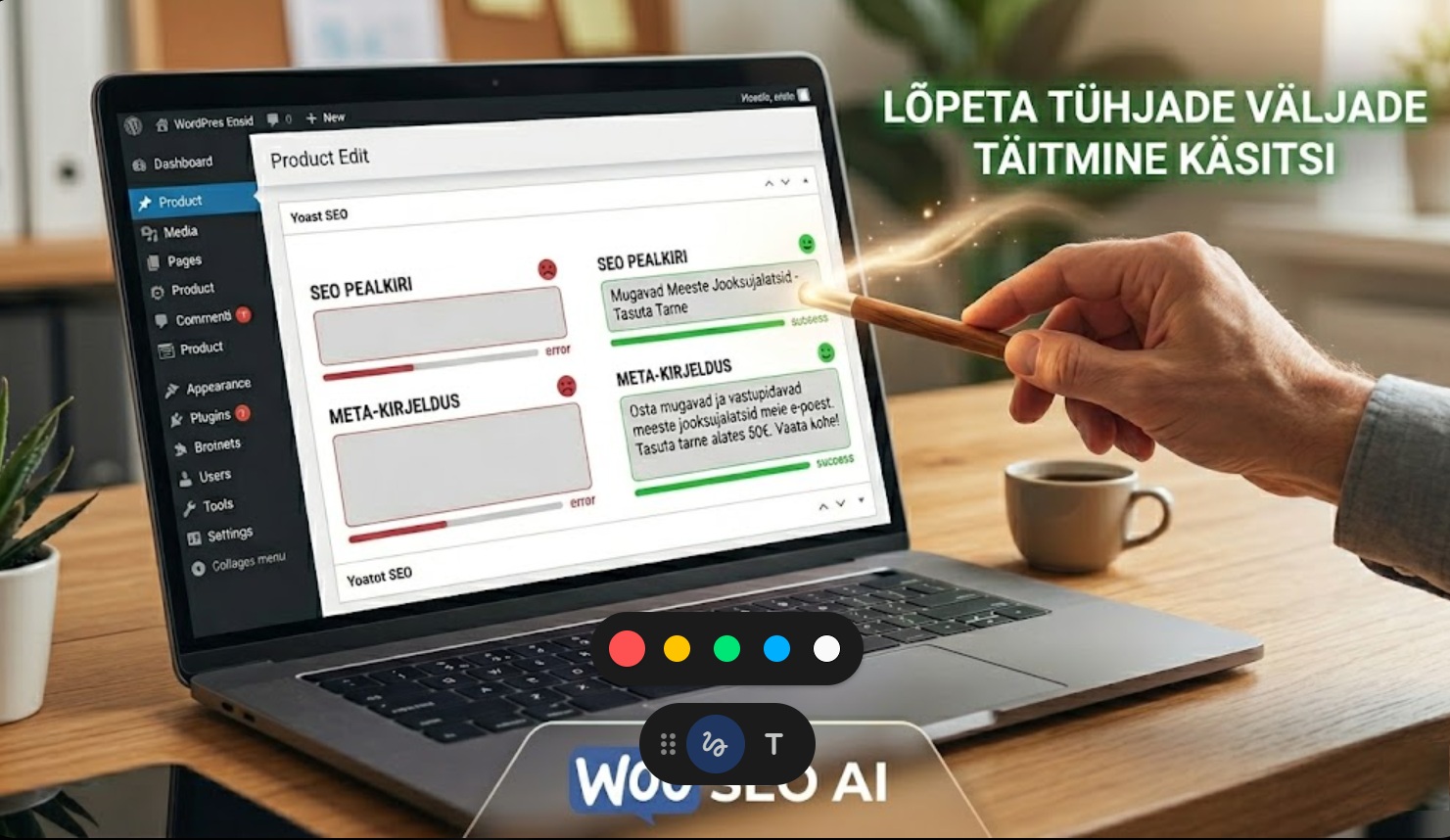
2. Missing or too short metadata
The SEO title and meta description are your store's "business card" in search results. If you leave them blank, Google will compile them from random text snippets. The result? Users won't click on your link because it doesn't seem relevant. Bing, which is growing in popularity in Estonia, generally doesn't show the website in the results in this case.
Solution: Optimize each title (up to 60 characters) and description (up to 160 characters) to be engaging and include important keywords.
3. Ignoring image ALT texts
Google bots don't "see" images, they read the code that accompanies them. If your product photos have empty ALT text or names like IMG_5678.jpg, you're missing out on a lot of traffic that could come from Google Image Search.
Solution: Describe the product in the image accurately using keywords that customers enter in their search.
4. Lack of structured data (Schema)
Have you noticed that some search results show stars, price, and availability? These are rich snippets (Rich Snippets), which are achieved through JSON-LD schemas. Without them, you're a grey mass among your competitors.
Solution: Add FAQ schema markup and product data markup to your products to catch the eye and increase credibility.
5. Doing SEO “sometime later”
Many e-commerce store owners think that SEO is a one-time project. In reality, it is an ongoing process. However, when you have 500+ products in your store, manually optimizing them can seem like an insurmountable mountain, which is why this work often goes undone.
This is where technology comes into play. Nowadays, you don't have to manually review each product. The tool we created to automate SEO and AI optimization of WooCommerce e-shop products allows you to use artificial intelligence to solve all the above errors in just a few clicks. This not only saves time, but also ensures that your store meets the latest Google requirements.
Summary
SEO doesn't have to be complicated or expensive. Start by taking a critical look at your most popular products. If you want to see how automation could work for your online store, try smart solutions that do the hard work for you.
Frequently Asked Questions (FAQ)
Yes, if you use high-quality templates like Gemini 2.5 Flash and review the content. Google's guidelines clearly state that what matters is the quality of the content and its value to the reader, not whether it was generated by a human or AI.
SEO is a long-term process, but adding technical metadata and FAQ schemas can increase visibility within 2–4 weeks when Google re-indexes your pages.
No, but for large stores, bulk processing is most effective. We recommend starting with the best-selling products or categories that are currently in low positions.